



About the Fund
The Free Enterprise Action Fund is the first mutual fund dedicated to providing both financial and pro-free enterprise ideological returns to investors.
Why invest in the Free Enterprise Action Fund? Left-wing social and political activists are harnessing the power, resources and influence of publicly-owned corporations to advance their social and political agendas. (1) Frustrated by their failure to advance their agendas in the public political process, these activists use capitalism against capitalism under the guise of “corporate social responsibility” and “socially responsible investing.” (2) Their movement threatens shareholder value and the American system of free enterprise.
Leveraging its status as an institutional shareholder in hundreds of America’s largest companies, the Fund aims to defend free enterprise from the Left’s use of capitalism against capitalism.
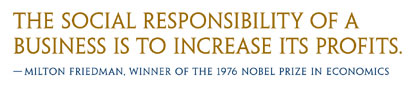
Our Core Principle. “The social responsibility of a business is to increase its profits.” [Milton Friedman Winner of the 1976 Nobel Prize in Economics]
Our Goals. The Fund’s conservative investment strategy is intended to provide dual returns for pro free enterprise-minded investors.
- A market-based financial return from investing in the common stocks of Fortune 500 companies. The Fund is a large-cap blend mutual fund that seeks results corresponding with the return of common stocks represented by the S&P 500 index. The Fund seeks to enhance portfolio return with certain additional investment strategies more fully described in the prospectus.
- A pro-free enterprise ideological benefit through advocacy that promotes shareholder value and defends the American system of free enterprise. By leveraging its shareholder status, the Fund seeks to counter-balance social activist pressure on corporate managements and strive to keep managements focused on lawful maximization of profits and shareholder returns rather than appeasement of social activists. The Fund aims to help enhance the performance of individual companies over the long-term while promoting the American system of free enterprise.
What actions will the Fund take? The Fund expects to accomplish its advocacy objectives primarily by directing efforts at corporate managements. Efforts will also be directed at institutional shareholders, the media and the public:
- Engaging corporate managements. We work directly with corporate managements to advance the Fund’s goals. These efforts may include meeting with management, attending shareholder meetings and filing shareholder resolutions to counter activist pressure campaigns and shareholder proposals.
- Using the media. We work with the media to inform institutional investors, individual investors, employees and the general public about attacks on businesses, how corporate managements respond to those attacks, and the Fund’s principles and actions.
- Marshalling support for Fund activism. We work to mobilize investor and public support to stop corporate managements from surrendering to activist demands and to advance the Fund’s goals.
The New Threat to Liberty: Using Capitalism Against Capitalism. We believe that social activist investors and anti-business activists threaten shareholder value and the American system of free enterprise. A Wall Street Journal editorial recently defined the problem as:
…“the new politics of capital,” in which liberal activists attempt to turn entire corporations into lobbyists for their social and political goals, their campaigns all neatly disguised as ‘shareholder activism’… (3)
Having failed to advance their agendas through our public political process, social activists operating under the banners of so-called “socially responsible investing” (SRI) and “corporate social responsibility” (CSR) aim to transform corporations – with their immense resources and influence – into instruments for advancing their social and political goals that we believe will harm shareholder value and the free enterprise system.
In the activists’ own words:
- People for the Ethical Treatment of Animals (PETA) “It’s far more effective to work through corporations and through the private sector to effect change” (4)
- Rainforest Action Network (RAN) “There has got to be some reassertion of democratic control. It is not happening through our government.” (5)
How anti-business activism works. Fearing negative publicity, personal attacks, shareholder pressure and product disparagement, corporate executives often choose to appease rather than to fight activists. Appeasement strategies, however, are often ineffective and may only signal corporate vulnerability that inspires activists to escalate attacks.
How big is the activist shareholder effort? Social activist investors operate approximately 200 SRI mutual funds with assets of approximately $35 billion. (6-7) These mutual funds provide activists with the institutional shareholder status and the financial resources that enable them to advance their social and political agendas. Social activist investors file hundreds of shareholder resolutions every year in hopes of advancing their agendas. (4)
What is the harm? Activist attacks on corporations may have adverse consequences extending far beyond negative financial impact on shareholder value.
- Circumventing democracy. Our traditional political process can be circumvented and undermined when corporate executives make public policy via private arrangements with activists.
- Eliminating business as a defender of free enterprise. Corporations may be intimidated from participating in public policy debates and are discouraged from funding free market public policy organizations.
- Blocking economic development. Developing nations, which could be a significant part in our future economic growth, are blocked from access to the financial resources they need to develop economically.
Recent examples of activist attacks on corporations:
- Stifling social security reform. Union pension funds intimidated financial services companies from participating in the 2005 debate over social security reform. This important public policy objective will not likely succeed without the support of the financial services industry.(3)
- Preventing economic development. Social activists and investor groups pressured Citigroup, Bank of America, Wells Fargo, JPMorgan Chase and Goldman Sachs into subjecting their lending practices for developing nations to criteria established by the activists.(8) Under pressure, Citigroup “partnered” and sought the counsel of environmental activist groups that have publicly disparaged the bank’s reputation. (9) Despite a worldwide coffee glut, activists pressured consumer products giant Procter & Gamble into paying above-market prices for coffee that is subsequently retailed as so-called “fair trade” coffee. (10)
- Lobbying for the activist agenda instead of a core business threat. Environmental activists and activist investor groups pressured financial giant JPMorgan Chase & Co. to assemble a coalition of banks to lobby governments on global warming.(11)
- Political contribution intimidation. Activist investors have pressured pharmaceutical and media companies to disclose their business rationales for political contributions. (12)
- Not defending of profits and property rights. A hostile business environment has caused the CEO-trade group called the Business Roundtable to engage in public relations campaigns rather than leading the effort to defend the fundamentals of capitalism. (13)
Who will manage the Fund? The fund is managed by Action Fund Management, LLC, a registered investment advisor. The principals of AFM are Thomas Borelli, PhD, and Steven Milloy, MHS, JD, LLM, who have 30 years of combined experience in public policy issues and advocacy.
How do I invest in the Free Enterprise Action Fund? For a copy of the prospectus and investor application forms for the Free Enterprise Action Fund, call 1-800-766-3960 or write to Free Enterprise Action Fund, P.O. Box 182490, Columbus, OH 43128-2490 or visit www.FreeEnterpriseActionFund.com
Equity securities (stocks) are more volatile and carry more risk than other forms of investments, including investments in high-grade fixed income securities. The net asset value per share of this Fund will fluctuate as the value of the securities in the portfolio changes. The Free Enterprise Action Fund is a new fund with limited investment history and there is no guarantee that it will achieve its investment objectives.
An investor should consider the fund's investment objectives, risks, and charges and expenses carefully before investing or sending money. This and other important information about the Free Enterprise Action Fund can be found in the fund's prospectus. To obtain a prospectus, please call 1-800-766-3960 or visit www.FreeEnterpriseActionFund.com. Please read the prospectus carefully before investing.
Mutual fund investing involves risk, including loss of principal.
The Free Enterprise Action Fund is advised by Action Fund Management, LLC., which receives a fee for its services, and is distributed by Northern Lights Distributors LLC, which is not affiliated with Action Fund Management, LLC.

References:
1. Biz-War and the Out-of-Power Elite: The Progressive
Left Attack on the Corporation.
2. Ibid.
3. The Wall Street Journal, Pension Fund Blackmail
(March 31 2005),
http://online.wsj.com/article/
0,,SB111222906625193741,00.html.
4. Christian Science Monitor, Today's Lobbyists Take
Two Roads (April 18, 2005),
http://www.cbsnews.com/stories/2005/04/18/national/
printable688712.shtml.
5. Multinational Monitor, Running over Citi Banking
Goliath Citigroup Agrees to Environmental Screens for
Project Financing in the Developing World (Jan/Feb 2004,
Volume 25, Nos.1&2)
http://www.multinationalmonitor.com/mm2004/04jan-feb/
jan-feb04interviewhogue.html.
6. Washington Post, Social Responsibility Doesn't Much
Sway the Balance Sheet (October 5, 2005),
http://www.washingtonpost.com/wp-dyn/content/article/2005/
10/04/AR2005100401689_pf.html.
7. MarketWatch, ETFs find their conscience: First socially
responsible ETF takes unique approach (Feb. 20, 2005),
http://www.marketwatch.com/news/story.asp?dist=¶m=
archive&siteid=mktw&guid=%7B414576B4%2D46EC
%2D478F%2D93F8%2DA65ED63C3D2B%7D&garden=
&minisite.
8. Rainforest Action Network, Global Finance Campaign http://www.ran.org/ran_campaigns/global_finance/
(accessed
Jan. 3, 2006).
9. FreedomWorks, The Corporate Boardroom is the Latest
Political Battleground (November 15, 2005),
http://www.freedomworks.org/informed/
issues_template.php?issue_id=2411.
10. Domini Social Investments,
http://www.domini.com/about-domini/News/
Press-Release-Archive/P-G-Coffee.doc_cvt.htm &
http://www.domini.com/shareholder-advocacy/
Current-Wo/Fair-Trade/ (accessed Jan. 3, 2006).
11. National Review, Birkenstocks and Stocks:
"Like everything else,
investing is now politicized"
(July 4, 2005), http://www.nationalreview.com/.
12. Center for Political Accountability
http://www.politicalaccountability.net/
SP-JJ-ICCR%20release%20-%2004-05.pdf &
http://www.domini.com/shareholder-advocacy/
current-wo/political-/ (accessed Jan. 3, 2006).
13. Business Roundtable, INITIATIVE: S.E.E. Change
http://www.businessroundtable.org/taskForces/taskforce/
issue.aspx?qs=6F25BF159FF49514481138A6DF61851159169
FEB56A3AB4AF (accessed Jan. 3, 2006).